
Introduction
Walk onto almost any modern production floor and you'll notice something: the packaging line looks different than it did a decade ago. Robot arms swing where people once stood, guided by cameras and software instead of hand signals.
This shift isn't cosmetic. Manufacturers are turning to automation because the old model is breaking down. Labor shortages, rising throughput demands, repetitive-motion injuries, and inconsistent manual packing quality are pushing plants toward robotic solutions faster than ever.
The numbers back this up. The Manufacturing Institute projects that U.S. manufacturers will need to fill as many as 3.8 million jobs between 2024 and 2033, with roughly 1.9 million of those positions likely to go unfilled without major workforce changes.
This guide covers how robotic packaging actually works, where it delivers the most value, and what it costs to implement. You'll also see the challenges to plan around and how to pick an automation partner who can execute without dragging your project into chaos.
Key Takeaways
- Robotic packaging pairs robot arms, vision systems, and control software to automate picking, packing, and palletizing
- Global packaging robots market is projected to grow from $7.57 billion in 2025 to $23.49 billion by 2034
- Applications span pick-and-place, palletizing, case packing, inspection, and warehouse robotics
- Most systems pay for themselves within 1-3 years through labor savings and reduced waste
- Integration partner choice often matters more than the robot brand you pick
What Is Robotic Packaging Automation?
Robotic packaging automation uses programmable robots, sensors, and software to handle sorting, picking, packing, and palletizing tasks that used to require manual labor. Instead of a person eyeballing product placement on a conveyor, a robot equipped with vision guidance does it, thousands of times a shift, without variation.
Vision-guided systems give the cell that precision. Cameras and sensors detect a product's orientation, catch defects before they reach a customer, and guide the robot's arm to place items exactly where they belong. That accuracy is what separates a modern robotic cell from the rigid, single-task machines of the past.
Core Components of a Robotic Packaging System
Every robotic packaging cell relies on three core building blocks:
- Robot arm and end-effector: Grippers, suction cups, and mechanical fingers handle products of different shapes, weights, and fragility levels. A gripper built for rigid cartons won't work for soft bakery goods.
- Vision and sensor systems: Cameras detect product orientation and flag defects in real time, guiding accurate placement without requiring a human to check every unit.
- Control software and AI: Programmable logic directs robot motion, while AI-assisted simulation lets engineers model and test programs digitally first—cutting work that once took weeks down to days and reducing commissioning surprises.

Types of Robots Used in Packaging Automation
Robot geometry is matched to each task's speed, payload, and precision requirements. Five types dominate packaging lines:
| Robot Type | Best For |
|---|---|
| Articulated | Versatile, human-like multi-axis motion for complex pick-and-place |
| SCARA | Fast, compact operations like small-part insertion |
| Delta | Ultra-high-speed primary packaging picking |
| Cartesian/gantry | Heavy palletizing across large work envelopes |
| Collaborative (cobots) | Lower-volume or mixed-SKU lines working alongside people |
Delta robots show how fast this class of equipment has become. ABB's five-axis IRB 365, for instance, can pick, reorient, and place 1 kg products at 120 picks per minute under specific conditions. Actual rates shift with payload, gripper design, and product presentation, but the figure marks a realistic performance ceiling for lightweight primary packaging.
Key Robotic Packaging Applications in Manufacturing
Robotic packaging isn't a single technology doing one job. It spans a range of applications, each solving a different bottleneck.
Pick and Place
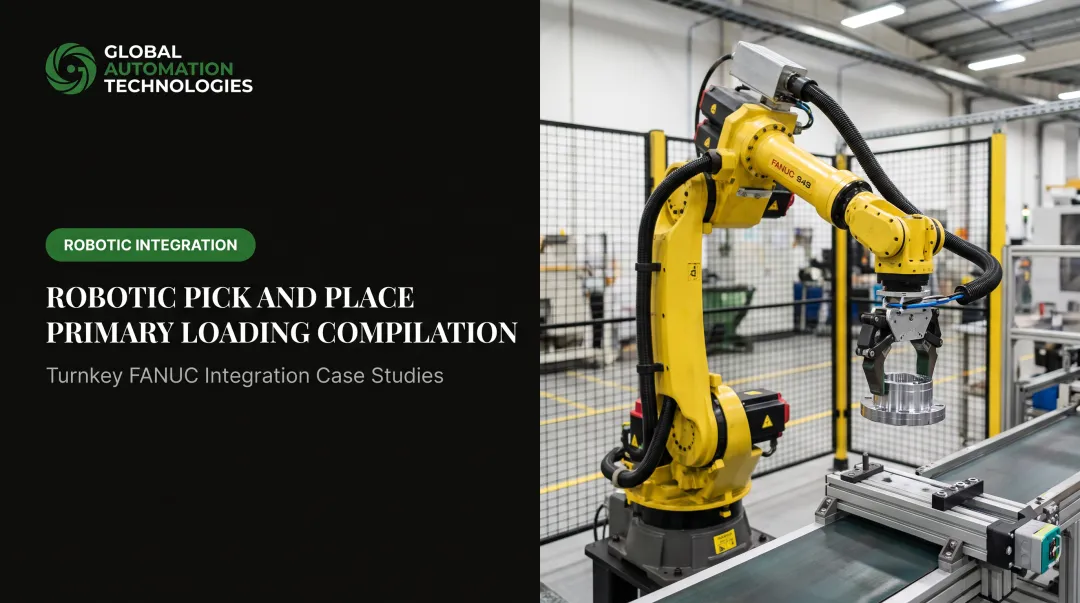
Vision-guided robots pick items off conveyors and place them into packaging or assemblies. In automotive manufacturing, this looks like a robot pulling molded parts, checking them with a camera, and routing them for packing—all within a tight cycle window.
GLOBAL Automation Technologies, a Level 5 FANUC Authorized System Integrator, has deployed vision-guided pick-and-place systems across automotive, EV, heavy equipment, and appliance manufacturing. That includes camera-guided random bin picking for parts that arrive in unorganized bins rather than neat fixtures.
Palletizing & Depalletizing
Robots stack or unstack cases, bags, and parts onto pallets. This is one of the most physically demanding tasks in a warehouse, and it's exactly where automation earns its keep fastest. The robotic palletizer market alone was valued at $1.4 billion in 2024, with growth projected to $1.9 billion by 2029.
Case Packing, Boxing & Cartoning
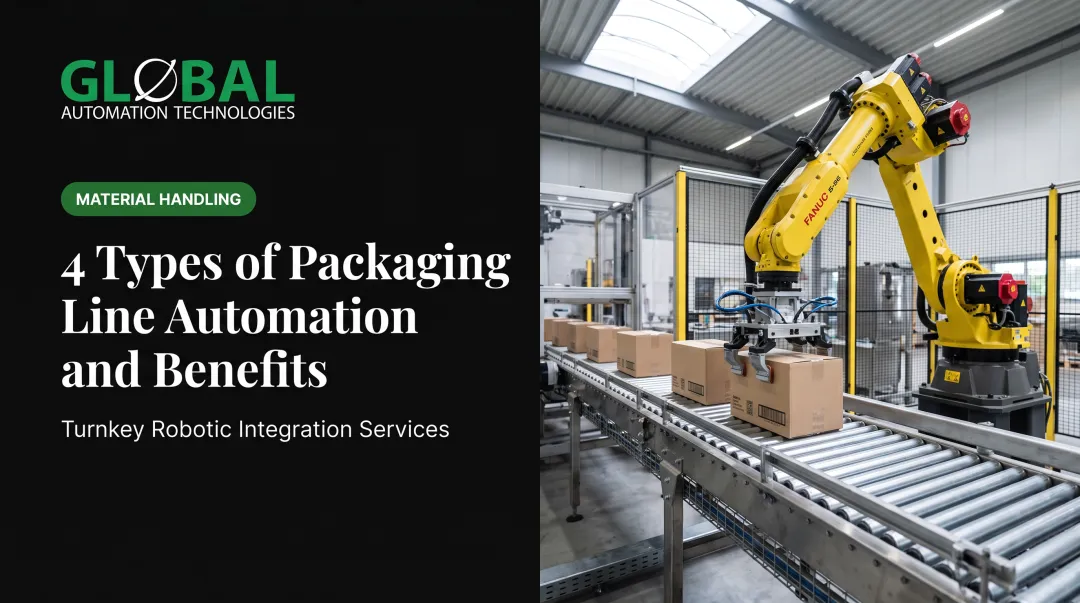
Robots group individually packaged products into cases or cartons and seal them for shipment. This matters most when products are delicate or irregularly shaped, since a robot programmed with the right end-of-arm tooling handles inconsistency far more reliably than a rushed human hand.
Depanning & Denesting
These specialized tasks remove baked or molded goods from trays, or unstack nested packaging materials. It's repetitive, precision-dependent work—and robots hold that accuracy shift after shift without fatigue-related errors.
Inspection & Quality Validation
Vision-equipped robots catch defects, mislabeling, or incomplete packs before products move downstream. Catching problems at this stage prevents returns and, in the worst cases, recalls.
Warehousing, AGVs & AMRs
Automated guided vehicles and autonomous mobile robots move palletized goods through the warehouse, extending automation past the packaging line itself. This is where packaging automation and warehouse logistics start to blend into one connected system.

Benefits of Robotic Packaging Automation
The case for robotic packaging comes down to five measurable advantages.
- Run continuously without fatigue—high-speed delta robots can exceed 100 picks per minute, a pace no manual line can hold shift after shift
- Lower injury exposure on the line—warehousing and storage workers face a total recordable injury rate of 4.8 cases per 100 full-time workers, much of it from lifting and repetitive motion
- Recover cost faster—McKinsey puts automation payback at 1 to 3 years, and packaging cells often land closer to the 12–18 month window seen in machine tending
- Hold quality steady—standardized motion paired with inline vision inspection cuts the packaging defects that manual handling and operator fatigue let slip through, keeping shipped-defect rates consistently low shift after shift
- Cover hard-to-fill roles—with manufacturers projecting nearly 1.9 million unfilled jobs through 2033, robots take on repetitive tasks that stay difficult to staff
Challenges to Consider Before Implementing Robotic Packaging
Robotic packaging isn't a plug-and-play decision. Three challenges come up on nearly every project:
- Upfront investment. Robots, tooling, and vision systems carry real capital cost. The robot itself often represents only about a third of total installed cost—design, guarding, and integration make up the rest. That hurdle hits smaller manufacturers hardest.
- Integration complexity. Retrofitting robots into an existing line means dealing with legacy PLCs, floor space limits, and cycle times set by upstream equipment. Poor integration planning leads directly to downtime.
- Product variability. Mixed-SKU or flexible lines often need reprogramming and recalibration. Vision-guided systems adapt to varied part presentation without constant retooling, so they hold up better than manual reprogramming on changeover-heavy lines.
How to Choose the Right Robotic Packaging Automation Partner
Buyers often fixate on the robot brand. In practice, the partner who designs, installs, and supports the cell has a bigger impact on results.
- Demand full turnkey capability. Look for layout, design, build, programming, validation, installation, and ongoing support under one vendor—not just hardware. A single owner removes multi-contractor coordination risk.
- Check whether they supply people, not just machines. GLOBAL Automation Technologies pairs automation solutions, services and technical staffing, so you get the robot and the engineers from one call. After commissioning, controls engineers and robot programmers keep the line running.
- Prioritize proven platforms and modern tools. Integrators using FANUC with AI-assisted simulation validate programs digitally in days instead of weeks on the floor, with fewer startup surprises.
- Ask about cross-industry experience. GLOBAL brings a proven global base of robotic deployments across automotive OEMs, Tier 1 suppliers, and heavy industry. A bin-picking method refined in automotive often transfers to aerospace or agricultural equipment lines.
Frequently Asked Questions
What is robotic packaging automation?
Robotic packaging automation uses robots, vision systems, and control software to automate picking, packing, and palletizing tasks. It replaces manual handling with programmable, precision-guided robotic motion.
How much does a robotic packaging system cost?
Costs vary with payload, robot count, and tooling complexity. Integration and design often make up the largest share of the investment. Most systems reach ROI within 1–3 years.
What industries use robotic packaging?
Food and beverage, automotive, pharmaceuticals, e-commerce, and heavy industry are among the most common adopters. Each sector applies the technology differently, from clean-room pharmaceutical packing to high-volume automotive part handling.
What's the difference between cobots and traditional industrial robots for packaging?
Cobots work safely alongside human operators and suit lower-volume, mixed-SKU environments. Traditional industrial robots are built for high-speed, high-volume dedicated packaging lines where raw throughput matters more than flexibility.
Can robotic packaging systems be integrated into an existing production line?
Yes, with a proper engineering assessment of floor space, legacy controls, and cycle time constraints. Working with an integrator experienced in retrofits reduces downtime risk during the transition.
How long does it take to implement a robotic packaging system?
Timelines depend on design and simulation, procurement, installation, and commissioning phases. AI-assisted simulation can shorten programming time from weeks to days and compress the overall schedule.